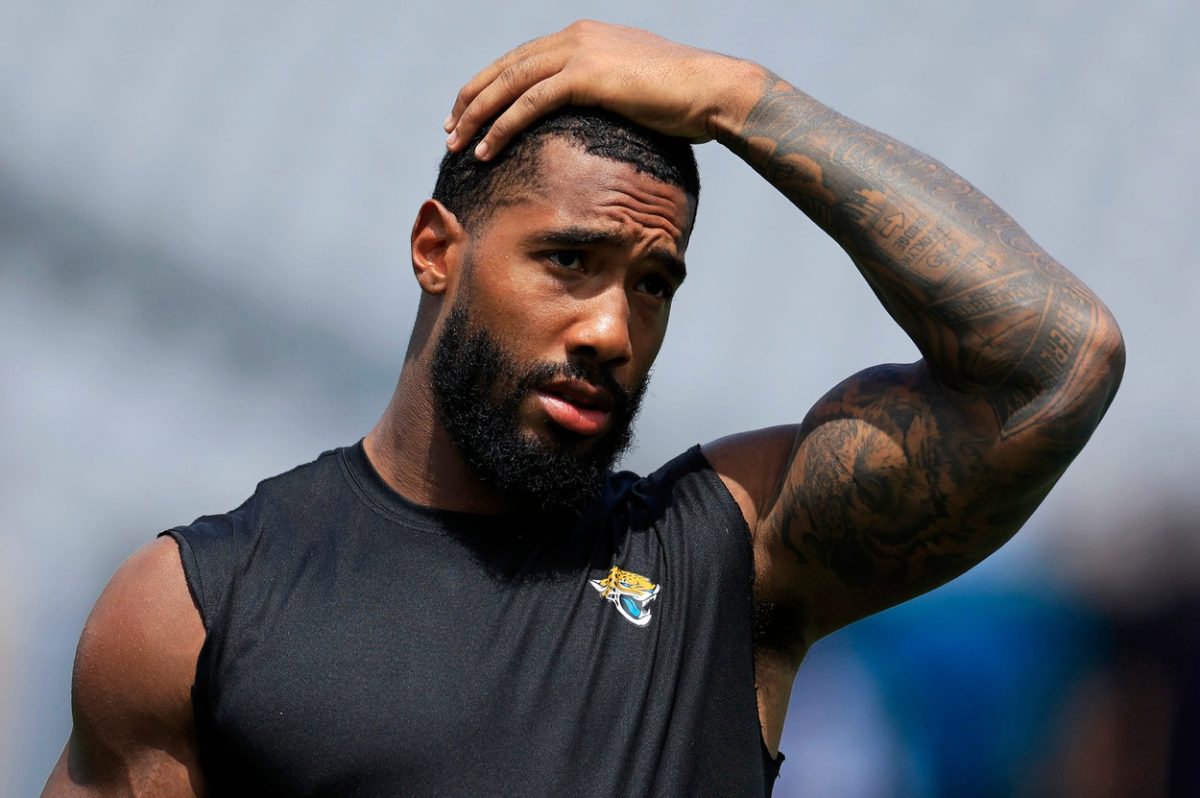


Parker Washington will play the most important season of his career for $3.67 million.
Contract talks between the Jacksonville Jaguars and their leading receiver have stopped without an agreement, and Washington intends to enter the 2026 season on the final year of his rookie deal. The Jaguars open Sunday against the Cleveland Browns.
Sources: Contract talks with the #Jaguars and star WR Parker Washington have come to a halt.
Washington, the former 6th-round pick, plans to bet on himself by entering the season without a new deal after months of negotiating. pic.twitter.com/0OAouLJsXq
— Jordan Schultz (@Schultz_Report) September 12, 2026
The two sides had negotiated for months, and as recently as Wednesday, the public signals pointed the other way. Washington told reporters the talks were active and that he wanted to stay.
Adam Schefter, on Wednesday’s “The Pat McAfee Show,” listed Washington among the extensions he expected to be finished before the opening games. Three days later the answer is no, and the receiver who spent the summer saying he would not let the contract become a distraction now gets to prove it.
What Washington is playing on
The numbers explain why this is a bet and not a standoff. Washington signed a four-year, $4.03 million contract as the 185th pick in 2023, and his 2026 base salary is $3.67 million after a proven-performance escalator, according to Spotrac, which lists his career earnings through three seasons at just under $2.8 million.
He is scheduled to be an unrestricted free agent in March. Jacksonville has said all along it was willing to keep talking into the season.
General manager James Gladstone told reporters during cut-down week that in-season negotiations were fine with him, and the team did exactly that with Jakobi Meyers and Cole Van Lanen a year ago. Washington’s preference ran the other way.
ESPN’s Jeremy Fowler reported last weekend that the player wanted the deal closed before Week 1 so it would not linger. Washington kept his own tone even.
Asked about the talks on Wednesday, he said the sides were still communicating and put it plainly.
Parker Washington – “The talks are continuing. I want to be here. The Jags want me to be here.”
— Ryan O'Halloran (@ryanohalloran) September 9, 2026
Both of those things can be true and still not produce a contract. What produces a contract is a number, and the halt says the two sides have not found one they share.
The comps that set the price
The receiver market moved twice this summer, and both moves cut against Jacksonville. Arizona gave Michael Wilson a three-year deal averaging $25 million, and Baltimore extended Zay Flowers at $35 million per year on a four-year, $140 million contract, per Over the Cap’s contracts table.
Washington’s own teammate sits between the floor and those deals: Meyers signed for $20 million per year on a three-year, $60 million extension after arriving at last year’s trade deadline.
Below Meyers is where the argument likely lives. Jayden Reed re-signed with Green Bay at $16.75 million per year, Jerry Jeudy is at $17.5 million and Khalil Shakir at $13.25 million.
Spotrac’s calculated market value for Washington is $14.1 million per year on a four-year deal — a model, not an offer, but a useful marker for how far apart a team-friendly number and a Wilson-tier ask could be.
That range is the whole story. If Jacksonville’s view is that a 24-year-old sixth-rounder with one 800-yard season belongs in the Reed-Jeudy band, and Washington’s camp is pricing him against Wilson and the slot-heavy usage that made him Trevor Lawrence’s most reliable target, there is a $7 million to $10 million gap per year and no obvious mechanism to close it in September.
Why Jacksonville can wait, and why Washington couldn’t make them
The Jaguars have been aggressive extenders under Gladstone and head coach Liam Coen. Travon Walker signed a four-year, $110 million deal in April, Brenton Strange got three years and $36 million in June and Meyers was locked up in-season.
Washington was the third name on that offseason list, and he is the only one still waiting. That is not an accident of scheduling.
Jacksonville holds the franchise tag for 2027 and has shown it will negotiate in November, which means Week 1 was a deadline for Washington far more than for the team.
Every week he produces raises his number; every week he doesn’t, or gets hurt, lowers it. A player earning $3.67 million absorbs all of that variance. A team with the tag in its pocket absorbs almost none.
The tape says the variance could run his way. Washington played 16 games last season and caught 58 passes on 95 targets for 847 yards and five touchdowns on 58.5 percent of the offensive snaps, and he did it while Brian Thomas Jr. struggled through his second season and Travis Hunter was lost for the year after Week 7 with a knee injury.
He also returned two punts for touchdowns, a franchise first for a single season, and said Wednesday he will keep that job. The prior two years were 32 catches for 390 yards and 16 for 132.
That is the counterargument in one line: one breakout season, achieved partly because the receivers drafted ahead of him were unavailable. Jacksonville is paying to find out whether 2025 was the floor or the ceiling, and it has decided the answer is worth a few more weeks.
Fantasy read
Nothing about the contract changes Washington’s Week 1 usage, but the room around him does. He led the position group in snaps through camp alongside Meyers, and with Hunter back and Thomas healthy the target tree is more crowded than it was during last December’s run of 100-yard games.
Treat him as a WR3 with flex upside against Cleveland, not a locked starter.
Where the contract does matter is the waiver claim calculus: a player with $3.67 million on the line and free agency in March is not going to be rested for anything short of a real injury.
In deeper leagues he’s a hold, and if Sunday’s target share tracks last season’s 17-18 percent, he’s a buy before the price catches up to the usage.