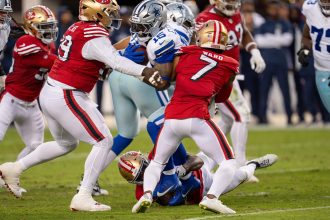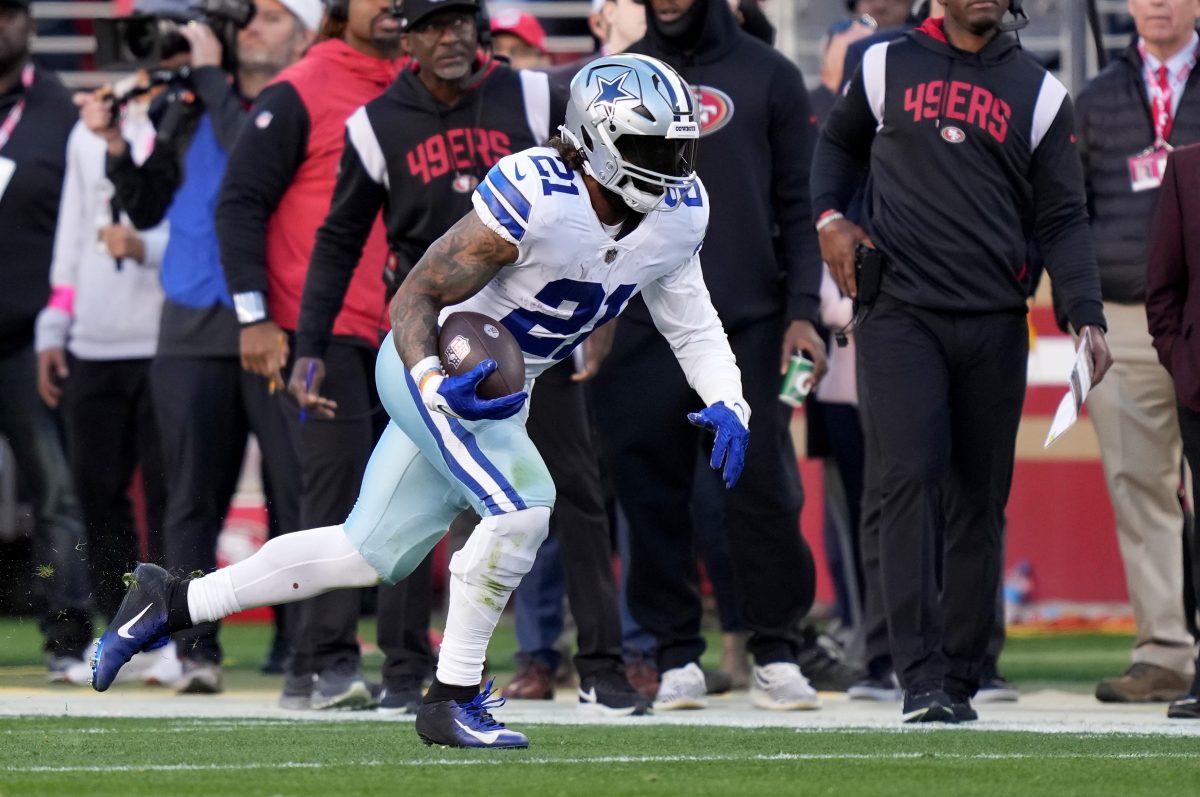


Jake Ferguson will not have to pay the $13,611 fine imposed over his touchdown celebration against the Washington Commanders after successfully challenging the NFL’s interpretation of the gesture.
The Dallas Cowboys tight end explained that he was pretending to drink Gatorade. His argument included a history of performing the celebration at practice, with the Cowboys having documented those instances on social media.
NFL rescinded the $13,611 fine given to Cowboys TE Jake Ferguson for saying he was “shotgunning a beer”. Ferguson told the league it was his Gatorade celebration that he previously had done on multiple occasions in practice, as the team had documented on social media. Fine…
— Adam Schefter (@AdamSchefter) October 7, 2026
The reversal, reported Wednesday, resolves a dispute that began with a celebration in Dallas’ Week 2 victory. It also gives Ferguson a different outcome from the one announced when the league first assessed the penalty: The gesture will no longer cost him five figures.
The celebration footage and the NFL’s description of Ferguson’s act was an “imitation of shotgunning a beer.” The disagreement centered on what Ferguson was representing, rather than an allegation that he actually consumed alcohol during the game.
Another round: Cowboys TE Jake Ferguson was fined $13,611 for what the NFL said was his “imitation of shotgunning a beer” Sunday vs. Washington that “constituted an offensive demonstration and could reasonably could be construed as being in poor taste.” pic.twitter.com/VB8sp2zu07
— Adam Schefter (@AdamSchefter) September 25, 2026
That distinction became central to his defense. Ferguson pointed to an existing celebration associated with a different drink, giving his appeal context beyond the end-zone moment itself.
Why Ferguson’s appeal matters
There is an important distinction about who reversed the punishment.
Adam Schefter clarified Wednesday that a hearing officer jointly appointed by the NFL and NFL Players Association decides these appeals. The decision should not be described as the NFL simply choosing to withdraw its own assessment.
Clarification: The appeals are heard by hearing officers jointly appointed by the NFL and the NFLPA. The NFL doesn’t overturn the fine; the appeals officer does. https://t.co/sFsM1FUAAx
— Adam Schefter (@AdamSchefter) October 7, 2026
Under the league’s published appeals process, a player who challenges discipline receives a hearing before an assigned appeals officer. That officer reviews the play and considers both the league’s position and the player’s defense before issuing a binding decision.
The initial notification includes the alleged violation, the amount of the fine and video of the play, along with instructions for challenging the punishment. A player therefore has an opportunity to dispute the league’s account before an assessed amount becomes a final financial penalty.
When a fine is rescinded, the NFL’s policy says the player is notified and the money is not deducted from his check. That is the practical consequence for Ferguson, whose successful appeal eliminates the $13,611 obligation.
The reported practice evidence helps explain his argument, but the available account does not establish how much weight the hearing officer assigned to each piece of evidence. It would go beyond that reporting to say a particular video alone decided the case.
Kyle Juszczyk also wins a celebration appeal
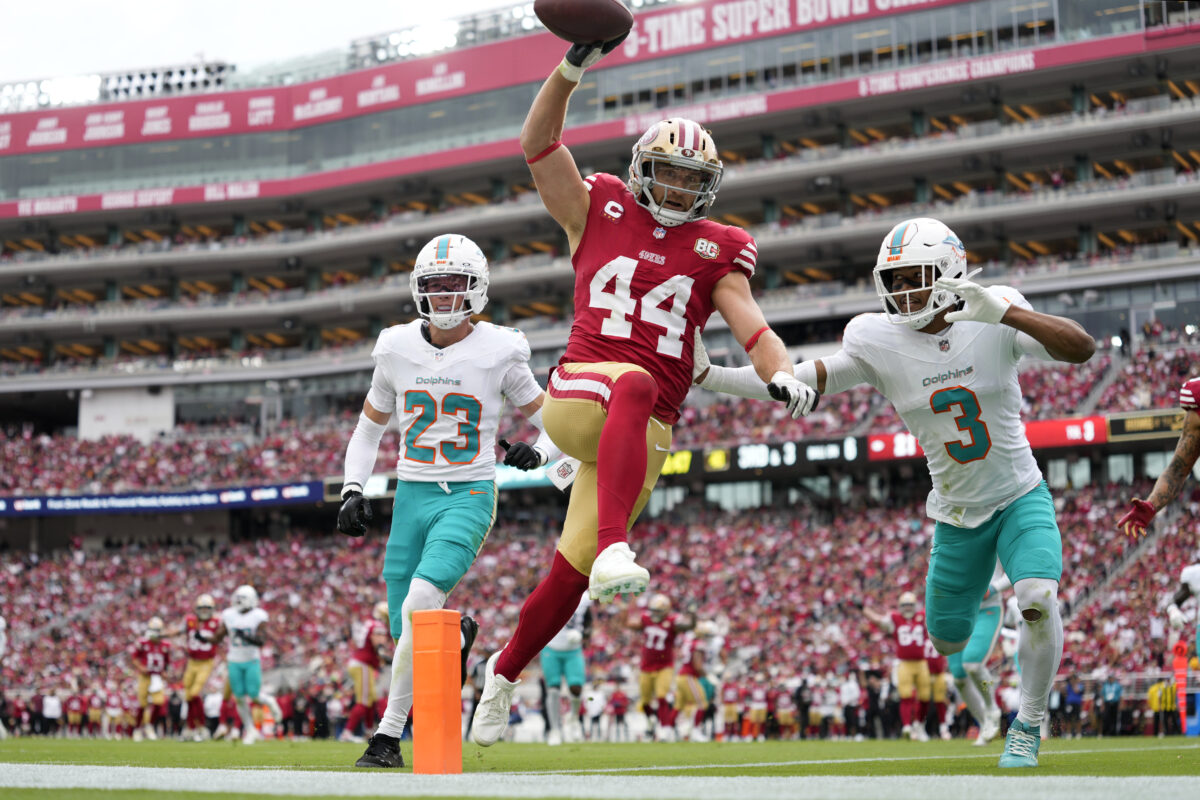
Ferguson was not the only player to receive a favorable decision involving a drinking gesture. A $14,926 fine against Kyle Juszczyk had been rescinded after the San Francisco 49ers fullback disputed the interpretation of his celebration.
The NFL has rescinded the $14,926 fine it imposed on 49ers FB Kyle “Juice” Juszczyk for what it thought was a distasteful celebration of chugging a beer. The league said it was withdrawing the fine “because his celebration was simulating drinking a juice box, not a beer….Mr.… pic.twitter.com/awg8qzchn9
— Adam Schefter (@AdamSchefter) October 7, 2026
For a player known by the nickname “Juice,” the distinction tied the gesture to his own identity. Ferguson’s defense instead pointed to Gatorade and the celebration’s use at Cowboys practices.
The cases share a basic issue: A motion interpreted as an alcohol reference can have a different explanation from the player performing it. Each appeal produced relief from a specific punishment, rather than a publicly announced replacement for the league’s celebration standards.
The amount in Wednesday’s Juszczyk report is also worth keeping precise. It identifies a $14,926 fine.
That should not automatically be expanded into a claim that every fine assessed to him, or every player involved in similar celebrations, has been overturned.
The celebration followed a two-touchdown game
The play that generated Ferguson’s fine came during a productive afternoon for the Cowboys offense. Dallas beat Washington 37-20 on Sept. 20, with Ferguson and CeeDee Lamb each catching two touchdown passes from Dak Prescott.
In the Cowboys’ contemporaneous account of the victory, Ferguson emphasized the collective work behind that performance.
“That’s a full team effort right there — all three phases,” Ferguson said.
He also connected the passing game’s success to offseason throwing sessions, describing the work teammates had done together when fewer players were in town.
Those remarks concerned the team’s performance, not Wednesday’s appeal, but they capture the setting in which the celebration occurred.
Prescott threw four touchdown passes as Dallas earned its first win of the season. He also moved ahead of Tony Romo as the franchise’s career leader in touchdown passes, giving the home victory significance beyond the later disciplinary debate.
Through four games, the Ferguson has 12 receptions for 83 yards and three touchdowns. His two scores against Washington account for most of that touchdown total.
The appeal affects his fine, not those results or the production recorded during the game.
What the ruling changes
Ferguson’s case follows the broader scrutiny of celebrations that Ahn Fire Digital covered in its report on the NFL’s Week 2 unsportsmanlike conduct fines. That earlier reporting concerned penalties assessed, a category that must be distinguished from money ultimately collected after appeals.
The NFL describes its conduct system as a jointly established framework with the players association. It covers unsportsmanlike behavior as well as player safety, and the league says players receive information about prohibited conduct, fine amounts and appeals before the season.
The league also says collected fines support the Professional Athletes Foundation and NFL Foundation. Those stated purposes explain how the system is designed; they do not resolve whether an individual celebration was correctly interpreted.
For Ferguson, that individual question has now produced a favorable outcome. His explanation was presented through the appeal process, and the $13,611 fine will not stand.
Any broader conclusion about how officials or disciplinary staff will treat future celebrations would require a separate policy announcement or further rulings.